
INNOVATIONS
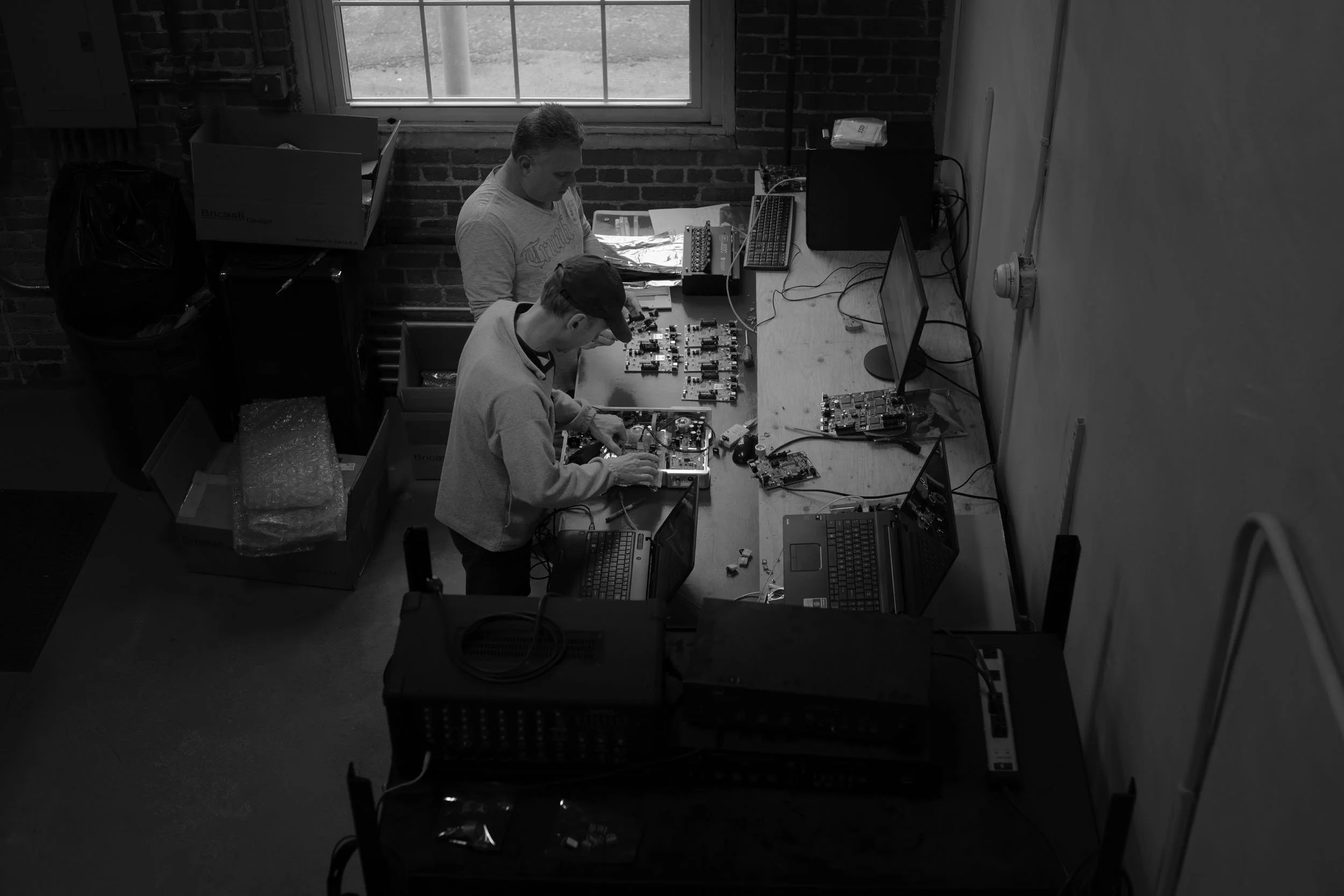
ESTABLISHING THE TECHNICAL DNA
From our earliest work in professional digital signal processing, we have treated product development as a disciplined engineering exercise. Studio environments demand reliability, repeatability, and measurable performance, standards that continue to guide every professional and consumer component we design.
Rather than pursuing rapid product cycles, we develop platforms that evolve over time. Extensive prototyping, circuit refinement, and long listening evaluations are part of a deliberate process focused on precision rather than novelty.
Our approach to innovation is cumulative. Each platform builds on the last, refined through disciplined engineering rather than replaced by trend. From signal processing to digital conversion, amplification, and acoustic design, every development follows the same core principles of precision, stability, and system coherence.
Setting Gold Standards
The M7 Stereo Reverb Processor was our first major statement. Built around proprietary reverberation synthesis rather than convolution techniques, it quickly became a trusted reference tool in professional recording and mastering studios worldwide.
The M7 remains in production today, a reflection of the architectural stability and long-term design philosophy that define our approach to audio engineering. The principles on which it was built, precision DSP coding, signal integrity, and disciplined circuit implementation, continue to underpin our technological advancements as we move forward.
M7 Reverb Processor, 2007
M1 Stereo D/A, 2011
Transition from Processing to Playback
In 2011, we launched our first consumer component, the M1 DAC. Drawing on our studio experience in signal processing and conversion, the M1 brought professional-grade digital precision to the high-end home audio market.
The M1 architecture demonstrated that studio discipline could translate directly into refined musical reproduction in the home, establishing a platform that combines careful digital design with fully balanced analog output stages, one that continues to evolve across subsequent generations.
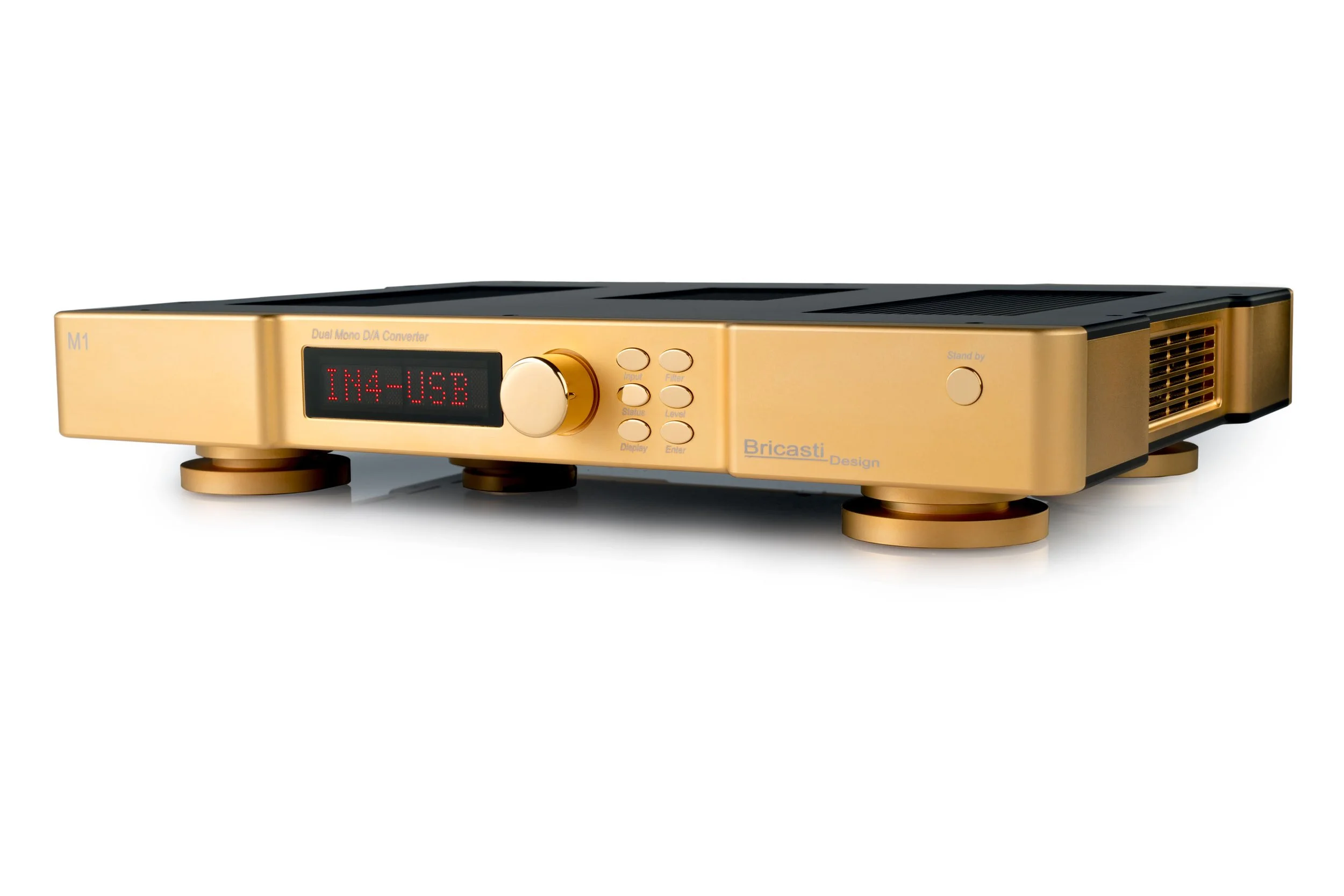
M1 Limited Gold Edition Stereo D/A, 2015
Defining Expression
The M1 Limited Gold Edition marked a significant milestone in the development of our original DAC platform. While retaining the core architecture that defined the M1, this limited-production version introduced enhanced machining tolerances, improved assembly processes, and a fully gold-anodized chassis. Produced in strictly limited quantities, it demonstrated our commitment to technical integrity and our ability to achieve exceptional precision in execution.
M28 Monoblock Amplifier, 2015
Fully Differential Amplification
In 2015, we launched the M28 monoblocks, marking our entry into fully differential power amplification. Designed with the same rigor as our digital platforms, the M28 features dual differential circuitry, substantial power reserves, and precise current delivery.
Intended for both professional and home hi-fi systems, it emphasizes channel separation, load stability, and linear behavior across the dynamic range. This established the foundation for our amplifier designs, emphasizing a fully balanced topology and architectural continuity that becomes evident when integrated into a complete Bricasti Design system.
M12 Source Controller Stereo D/A and Network Streaming Integration, 2016
Integrated Network Architecture
With the introduction of the M12 Source Controller in 2016, we combined stereo DAC functionality with an analogue input stage, expanding system flexibility within a single platform. At the same time, we launched our Network Player card, which allows for seamless integration of streaming capabilities into our digital architecture.
Designed for stability and clock integrity, this modular implementation later became a defining element across other Bricasti DAC sources.
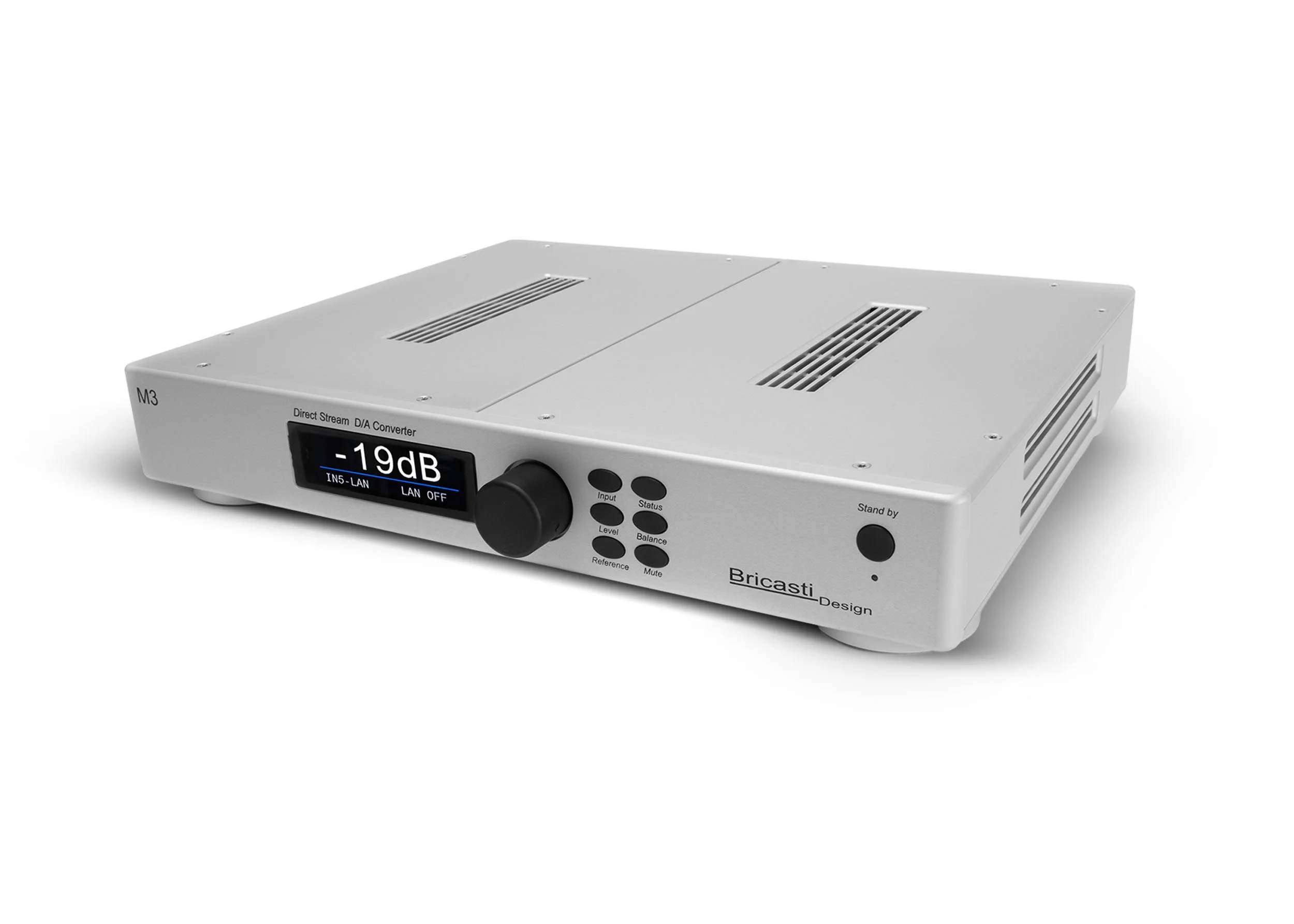
M3 & M3H Stereo D/A, 2019
Expanding Performance Accessibility
In 2019, we introduced the M3 DAC, extending our digital architecture to a more accessible price point. Incorporating Delta Sigma conversion, native DSD decoding, and precision DDS clocking for exceptionally low jitter, the M3 maintained the precision and stability central to our design philosophy.
With optional integrated headphone output and network capability, the M3 broadened versatility while preserving a fully balanced signal path. It marked an important expansion of our digital portfolio without departing from core engineering principles.
M20 Preamplifier, 2020
Completing the Signal Chain
The launch of the M20 preamplifier marked our expansion into analog signal control. Fully balanced from input to output, the M20 was designed to deliver transparency, low noise performance and precise gain management in complete Bricasti systems or mixed environments.
Careful attention was given to circuit layout, power supply regulation and channel matching, ensuring signal integrity throughout the path. By unifying digital conversion, amplification and preamplification under one design philosophy, we extended our engineering approach across the full electronics chain.
M21 Stereo D/A, 2021
Multi-Architecture Conversion Platform
The M21 represented a significant convergence of our digital research and the continued evolution of both the M1 and M12 Source Controller. Within a single chassis, we brought together three independent, user-selectable conversion paths: Delta Sigma, R-2R ladder, and native 1-bit DSD.
Rather than favouring a single topology, the M21 reflects a broader design perspective, incorporating the MDx processor, network streaming, and a fully differential output stage. The M21 allows users to select the conversion architecture best suited to their system configuration and listening priorities, and, for the first time, enables a level of detailed personal choice in reproducing a cherished piece of music.
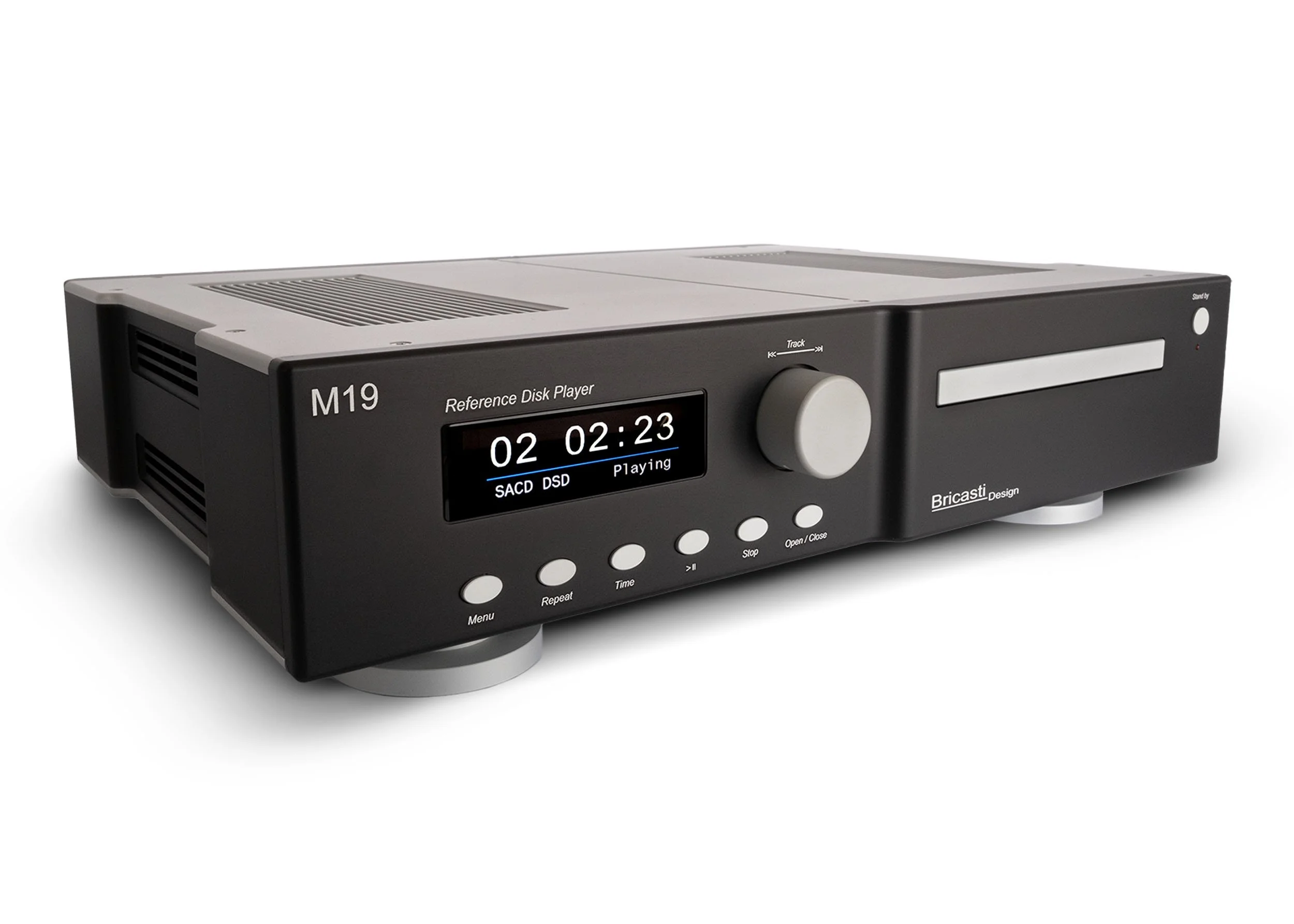
M19 SACD/CD Reference Transport, 2023
Source Integrity and Direct Interface
The M19 SACD and CD transport extended our control to the physical source stage. Designed with mechanical stability and clock discipline in mind, the transport was engineered to minimize timing errors before the signal reaches the conversion stage.
In addition to conventional digital outputs, we implemented a direct I2S connection for our compatible DACs. By reducing interface conversion stages and maintaining clock coherence between the transport and the conversion stage, the I2S pathway reflects our emphasis on preserving signal integrity from disc to analog output.
M11 R-2R Ladder Stereo D/A, 2024
Architectural Refinement
The M11 Series further refined our discrete ladder conversion platform, building upon the architectural foundation established at the highest level of our range. While that platform combined multiple conversion approaches within a single chassis, the M11 concentrates exclusively on R-2R ladder design, applying the same core engineering principles in a purpose-built architecture.
By focusing on a single topology, we were able to further optimize ladder linearity, power supply regulation, and analog stage performance, benefiting directly from that advanced research and development.
S7 Loudspeakers, 2026
Extending Engineering into Acoustics
With the introduction of the S7 loudspeaker, we extended our engineering philosophy beyond electronics into acoustic design. Developed to reflect the same precision applied to our digital and amplification platforms, the S7 integrates advanced driver technology, crossover networks, and controlled cabinet construction.
Rather than treating the loudspeaker as a separate discipline, we approached it as a continuation of systems thinking, prioritising mechanical stability, resonance control, and dynamic linearity to ensure the acoustic output remains faithful to the upstream signal.